Wednesday, March 7, 2007

Introduction


There are over 300 types of sharks in the world. Working in groups of four, you are going to find information on 5 types of sharks. With the information you find, your group will make a diorama illustrating where one of the sharks you researched lives. You will also make a story about the shark you chose.

Each member will be responsible for one part of the assignment, but everyone helps with every part of the assignment.

Descriptions - Everyone finds information and one member writes the descriptions of 5 sharks.

Habitat - Everyone finds information and one member writes about the habitats of the 5 sharks.

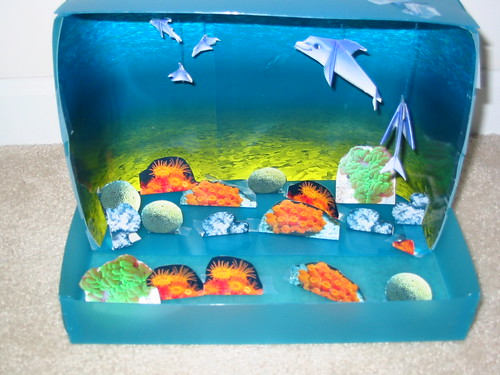
Diorama - Everyone provides ideas and helps create a diorama of the habitat of one shark that you have researched. One person in your group is responsible for making sure that it accurately shows the sharks habitat.

Story - One member writes a story but everyone gives ideas for the story.

To begin this assignment, go to the Finding Information pages for further directions. Also, review the grading rubric often to be sure you cover everything that you need. When you are finished, evaluate your group's project and give it a score based on the rubric.

Describe 5 Types of Sharks


The first thing your group should do is click on the link for the question worksheet. Everyone will need to find answers to the questions on the worksheet. Answer all of the questions for every shark that you are researching.

To answer the questions, click on the information links. You will find the descriptions of many sharks. Choose 5 sharks that you want to learn more about.

Click here for question worksheet. http://www.kidzone.ws/sharks/activities/ws5.htm

At the following website, click on the 'click here' link to see all of the topics on sharks. Or you can click on number 9 'Types of Sharks' to learn about more sharks.

Click here to find information on sharks. http://www.kidzone.ws/sharks/facts.htm

At the following website, click on the swimming lizard. It will lead you on a tour of various sharks.

Click here for more information. http://www.sharkfriends.com/diveintro.html


Find Information on Shark Habitats


If you need more information on your sharks habitat or characteristics, use the link below. When you use this link, it will show you lists of sharks that you can click on. There is more specific information on each shark in these links. The sharks are listed in alphabetical order.

Make sure all of the questions on your worksheet are answered. Think about which shark you want to make the diorama on. You should be able to answer the following question to make your diorama. - Where does your shark live? - What other animals live there? - What does your shark eat? - What does your shark look like?

Click here for habitat information.
http://www.42explore.com/shark2.htm

Project


Description Person - Now that you have answered all of the questions on your question worksheet, write the descriptions of the five sharks you have researched using the worksheet located in the description page link.

Habitat Person - With the information you have collected about the habitat of 5 sharks, write a description of their habitat using the worksheet located in the description page link.

Click here for the description page.
http://www.kidzone.ws/sharks/activities/ws6.htm


Diorama Person - Using classroom materials, build a diorama that shows that habitat of 1 shark. You will need to show what the shark looks like, other animals that live there, and what the shark eats. Include any other interesting information that you found if you can. For example, your shark may hide on the ocean floor and you could show the eyes looking up from the bottom of the box.
Attach a paper to the side or back of your diorama that says why you included each element of your diorama, and where you found that information.

Story Person - Create a story about the shark that you made the diorama for. Include at least three things that you learned about that type of shark. Be as creative as you want.
Attach a statement to end of the story telling which three things you added that you learned about, and where you got that information.

Use the links below to print out the title page and story pages to write your story on.

Click here for the title page.
http://www.kidzone.ws/sharks/activities/ws10.htm

Click here for the story pages.
http://www.kidzone.ws/sharks/activities/ws11.htm

Rubric


Team work:
5 - Everyone participated, was respectful, worked hard, stayed on task, and completed their individual part of the project.

3 - Most people contributed ideas, were respectful most of the time, stayed on task most of the time, most of the parts are completed.

1 - Little cooperation and involvement by team members, had difficulty respecting everyone's opinions, rarely on task, many parts are incomplete.

Descriptions:
5 - Complete sentences, paragraph form, specific identification of 5 sharks and their characteristics, identifies which website they found the information, well organized, shows evidence of thought.

3 - Some sentence fragments, needs work on forming paragraphs, missing information on some sharks, some information has citations, has some organization.

1 - No complete sentences, no clear paragraphs, missing a lot of information, no citations, not organized or thought out.

Habitat:
5 - Complete sentences, paragraph form, specific identification of the habitat of 5 sharks, identifies which website they found the information, well organized, shows evidence of thought.

3 - Some sentence fragments, needs work on forming paragraphs, missing information on some sharks, some information has citations, has some organization.

1 - No complete sentences, no clear paragraphs, missing a lot of information, no citations, not organized or thought out.

Diorama:
5 - Displays facts about 1 shark's habitat accurately, relatively to scale, includes a paper with citations about where displayed item information was found, has color, uses multiple materials.

3 - Displays facts about 1 shark's habitat with few generalizations, shows some attempt to make it to scale, includes a citation paper but missing some information, limited color and materials were used.

1 - Displays general facts about sharks, not specific to any particular shark's habitat, no attempt to make it to scale, missing citation paper, limited use of materials.

Story:
5 - Original story about a specific shark you researched, describes shark behavior and habitat or other information learned from the webquest (three specific details), attention paid to the elements of good writing, citation of where you found the information you used in the story.

3 - Original story about a specific shark you researched, missing some detailed information from the webquest, little attention paid to the elements of good writing, citation is missing elements.

1 - Story adapted from another story, not specific to any shark researched, missing detailed information from webquest, no evidence of understanding of writing elements, missing citation page.

Teacher Page


I would use this project for a third grade class.

Students will need:
- access to computers, a printer, shoe boxes, and art supplies
- to know the elements of good writing
- to know how to identify characteristics of sharks
- knowledge of how to move through a website
- approximately one to two hours of computer time to gather information. However, it should take one to two weeks for everyone to complete the whole project.

All members of each group need to work cooperatively to find the information and develop the projects. Specifically, everyone gathers information on the description of the sharks and one person does the final write up for the group. The same thing happens for the habitat paper. All members create the diorama and one person writes the citation page. The story should be created with ideas from all members but only one member writes the final story and citation.

Goals:
- Develop writing skills
- Learn how to research using the web
- Group collaboration
- Be able to identify various sharks
- Learn about various ocean habitats

A rubric is provided for students to evaluate their own work and for the teacher to evaluate the students work.